











The 12 Steps of AA and NA are more than a framework—they’re a proven path for lasting recovery, built on honesty, accountability, and connection.
Designed to help individuals break free from addiction and rebuild their lives, the 12-step model guides people through a process of self-reflection, spiritual growth, and meaningful change. For many men, it becomes the foundation not just for sobriety, but for rediscovering purpose, identity, and direction.
At Holdfast Recovery the 12 Steps are woven into every stage of our recovery journey. From early stabilization to long-term aftercare, this approach uses the steps to foster structure, discipline, and, most importantly, brotherhood.
Through shared experiences, mentorship, and consistent community support, men aren’t just working a program; they’re building relationships that sustain recovery. This continuum of care creates an environment where connection replaces isolation, and where lasting change is strengthened through accountability and a strong, supportive network.
How Did Alcoholics Anonymous and Narcotics Anonymous Start?
Not many people know that Carl Jung, the famous psychiatrist, played a role in the formation of the AA. He directed a young man called Rowland H from Rhode Island to a religious movement called the Oxford Group. Jung suggested that his condition was medically hopeless and that only a spiritual experience could help him.
Rowland H practiced the principles of the Oxford Group, had a religious experience, and overcame his alcoholism. A famous Wall Street banker called Bill W, whose alcoholism was crippling him, tried the method as a last resort.
Seeing the best doctors money could buy hadn’t worked — it was the spiritual awakening that made the difference. Bill W was inspired to share his sobriety success with the world, and the first AA book came out in 1939. NA was founded by Jimmy K. in 1953.
What Are the 12 Steps of AA/NA?
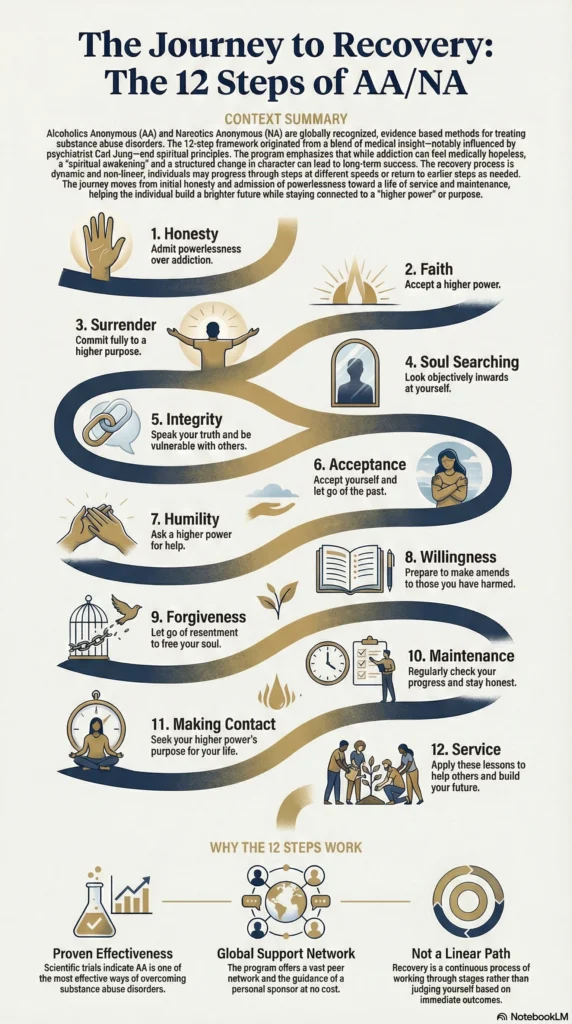
The 12 Steps of AA and NA aren’t just rules to follow—they’re a roadmap for real, lasting change. Recovery rarely moves in a straight line. Some steps come easily, while others take time, reflection, and courage.
It’s normal to feel like one step is harder than another, or even to connect with later steps before earlier ones. What matters most is committing to the process, not judging progress by how fast it comes.
Working through the steps opens a path to honesty, self-awareness, and connection. Step by step, people learn to face the truth about their past, take responsibility, and build a life that isn’t controlled by addiction.
Along the way, the support of others in the program becomes a lifeline: listening, sharing, and walking the journey together creates a sense of accountability and hope that can’t be found alone.
For anyone exploring recovery, understanding the 12 Steps is a powerful first step. Each step offers a guide, but it’s the community, the reflection, and the practice that make transformation possible. For those ready to take that next step, connecting with a local AA or NA program provides the support and guidance to begin, continue, and strengthen recovery—one honest, intentional step at a time.
Step 1: Honesty
Addiction causes a level of denial that can be quite challenging for onlookers to believe. No matter how much people push someone into recovery, unless they accept that there’s a problem, overcoming it is almost impossible.
The 12 steps begin with an admission that you are powerless over drugs or alcohol. Once you admit that it’s in control of you and not the other way around, you can get started.
Step 2: Faith
Secondly, you need to accept that there is a higher power in the universe than yourself. If you want God, or any higher power, to act on your behalf, it’s imperative that you believe it can. Accepting a higher power helps you to see life from a different perspective and creates a sense of accountability.
For those ready to explore this transformative step, joining a local AA or NA program offers the support and structure needed to make it real. In meetings, through shared stories and guidance, it becomes possible to experience this higher power in action.
Step 3: Surrender
Now that you have accepted a higher power into your life, welcome them by surrendering fully to a higher purpose. When people feel like their lives lack purpose and meaning, free will can run wild and lead you down dark pathways.
Surrendering to a higher purpose in AA/NA helps you focus on the true meaning within your life so you can feel like a valuable member of society again.
Step 4: Soul Searching
Soul searching is a process, just like recovery. There is no single moment that defines healing. Instead, it’s a culmination of intentions and actions that lead you down the right path. Soul searching involves looking objectively inwards at yourself.
When we’re caught up in addiction, our intentions can end up severely misaligned from how we behave. Soul searching will help you become the person you want to be.
Step 5: Integrity
Most of the people who don’t succeed in recovery struggle most with this step of the AA/NN journey. One of the hardest things in life is being honest about things that make us appear vulnerable in front of other people. However, the more you learn to speak your truth, unfiltered, the more you’ll get from the recovery process.
Step 5 of Alcoholics Anonymous (AA)—admitting the exact nature of past wrongs to a higher power, oneself, and another person—is often where real breakthroughs in addiction recovery begin. Many who struggle with sobriety find this step difficult, but it’s also one of the most powerful for long-term healing.
Step 6: Acceptance
Step 6 of Alcoholics Anonymous is a turning moment in the recovery process. This step shifts the focus from awareness to willingness, helping individuals prepare for real, lasting change by letting go of behaviors that fuel addiction.
In many successful addiction treatment programs, Step 6 is supported alongside evidence-based therapies like counseling and behavioral therapy, reinforcing both personal growth and accountability. While it can feel challenging, this stage is where transformation begins to take root.
Step 7: Humility
Antisocial behavior, such as using drugs or withdrawing from peers, often stems from a confused sense of self. When you let go and ask a higher power for help, you relieve a huge weight of pressure from your life.
Step 8: Willingness
You’ll write a list of the people you’ve harmed and ponder carefully over your past actions. Instead of feeling guilty or wallowing in emotion, you’ll think of ideas to make amends. Rather than seeing this as a check-box exercise, genuinely show a willingness to make amends.
Step 9: Forgiveness
If there are people in your past who have caused you pain or trauma or hurt you in any way, now is the time to let go. Resentment isn’t constructive for the mind. In fact, it breeds the type of feelings that make you more likely to turn to drugs or alcohol. Letting go of bad feelings — even if they’re aimed at people who do bad things — frees the soul.
Step 10: Maintenance
Throughout the entire process, you’ll be required to check back with yourself. Be totally honest with yourself about progress so that you can move forward. In real time, this may look like attending meetings, or continuing ongoing therapy.
Step 11: Making Contact
During step 11 of AA and NA, you’ll reach out to your higher power to find out what its purpose for you is. Everyone has a gift in life; no matter what it is, there’s something you can offer the world. When you’re working toward this purpose is when you’ll feel happiest.
Step 12: Service
Step 12 of Alcoholics Anonymous (AA), carrying the message and being of service to others, is where recovery becomes something that’s lived out daily. Helping others not only strengthens sobriety but also builds purpose, accountability, and connection that sustain long-term recovery.
For those ready to solidify their progress, staying active in service and connected to a recovery community can turn personal growth into lasting change.
Is AA Considered a Medical Treatment?
AA is not a medical treatment in the traditional sense, but it can play a critical role in a comprehensive recovery plan.
Unlike medication or formal therapy, AA focuses on peer support, personal accountability, and spiritual growth, helping individuals build the emotional and social tools needed to maintain sobriety.
While it doesn’t replace professional care, it complements evidence-based therapies such as cognitive-behavioral therapy (CBT) and trauma therapy. For many, combining AA with clinical support provides a stronger, more resilient path to long-term recovery.
By combining AA’s community-based support with clinical interventions, individuals can experience a well-rounded program that reinforces healthy habits, builds accountability, and maximizes the chances of lasting sobriety.
Advantages of the 12 Steps of AA/NA Explained
The 12 Steps of Alcoholics Anonymous (AA) remain one of the most widely used and effective approaches to addiction recovery. For those asking “do the 12 steps really work?” or “what are the benefits of AA?”, the answer often lies in the unique combination of accessibility, structure, and community support. These advantages make the 12-step model a powerful foundation for both early recovery and long-term sobriety.
Free and Accessible Addiction Support
One of the biggest benefits of AA is that it’s completely free. There are no membership fees, making it accessible to anyone seeking help regardless of financial situation. This removes a major barrier to entry and allows individuals to attend meetings consistently—an essential factor in maintaining sobriety. Many treatment programs encourage ongoing AA participation as part of aftercare because of this built-in accessibility.
Sponsorship and Personalized Guidance
AA offers something many recovery paths lack: direct, one-on-one mentorship through sponsorship. A sponsor is someone who has walked the path of recovery and can provide guidance, accountability, and real-world insight. This relationship helps individuals navigate challenges, stay committed to the 12 steps, and build trust—key elements for preventing relapse and sustaining progress.
Proven Effectiveness in Recovery
Research and long-term outcomes continue to show that 12-step participation can significantly improve recovery success rates, especially when combined with professional addiction treatment like therapy or outpatient programs. The structure of the steps, combined with peer accountability, creates a system that supports behavioral change, emotional healing, and long-term sobriety.
Integrating 12 Steps with Professional Treatment at Holdfast Recovery
Taking the next step in recovery doesn’t have to be done alone. While the 12 Steps of AA provide a powerful foundation for lasting sobriety, combining them with a structured addiction treatment program can significantly improve outcomes.
Professional support found in structured outpatient programs at Holdfast Recovery might include individual or group therapy, medication support, case management, and equine therapy, such as working with donkeys.
For those ready to move beyond meetings and build a more comprehensive recovery plan, exploring additional treatment options can be a turning point. For individuals who need a higher level of care, our brother program, AnchorPoint, offers structured residential treatment and more intensive support.
We offer integrated recovery pathways, including Christian rehab, care for first responders, veteran mental health treatment, and other tracks for men from all backgrounds who are ready to transform pain into strength. Contact our admissions team to connect with treatment designed to help you rise stronger in recovery.